While attending the Pre-SDOI Training Camp (also known as "Public Easy Round #2") hosted by country P, you encountered the following problem:
Given a directed graph $G$ with $n$ vertices and $m$ edges, it is guaranteed that its underlying undirected graph $G'$ is a cactus and contains no multiple edges or self-loops. You need to find the number of ordered pairs $(x, y)$ such that there exists a path from $x$ to $y$ in $G$. Specifically, $(x, x)$ must also be counted in the answer.
Definition of a cactus: A connected simple undirected graph where every edge belongs to at most one simple cycle.
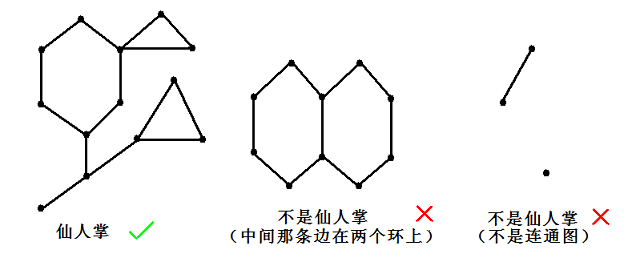
Definition of an underlying graph: For a directed graph $G=(V, E)$, define a new undirected graph $G'=(V, E')$, where $E'$ is the set of edges obtained by replacing every directed edge in $E$ with an undirected edge. $G'$ is called the underlying graph of $G$.
Input
The first line contains a positive integer $T$, representing the number of test cases. For each test case:
- The first line contains two positive integers $n$ and $m$.
- The next $m$ lines each contain two positive integers $u$ and $v$, representing a directed edge from $u$ to $v$.
Output
For each test case:
- A non-negative integer representing the answer.
Examples
Input 1
2
3 3
1 2
1 3
2 3
5 5
1 2
2 3
3 4
4 5
4 2
Output 1
6
18
Input 2
See provided files.
Constraints
For all test cases, it is guaranteed that $1 \le T \le 10^5$, $2 \le n \le 2.5\times 10^5$, $n-1 \le m \le \left\lfloor \dfrac{3(n-1)}{2}\right\rfloor$, and $\sum n \le 2.5\times 10^5$.
| Subtask ID | Additional Constraints | Score |
|---|---|---|
| $1$ | $n \leq 8, m \leq 10$ | $1$ |
| $2$ | $6$ |