Given $n$ and an integer sequence $a_0, a_1, \cdots, a_n$ of length $n+1$.
There is a piecewise function $f(x)$ with domain $[0, n]$, defined as follows:
- If $x$ is an integer, $f(x) = a_x$.
- Otherwise, let $k = \left\lfloor x \right\rfloor$, then $f(x) = a_k + (x - k)(a_{k+1} - a_k)$.
Now, two players, Min and Max, play a game. Before the game, both parties agree on a positive integer $A$ and a positive real number $\varepsilon$, and set the parameter $T = A$.
Subsequently, Max chooses a real number $x \in [0, n]$, and the game begins. Both players take turns modifying $x$, with Min going first, according to the following rules:
- If $T \le 0$, the game ends immediately.
- The current player chooses another real number $x'$ such that $x' \in [0, n]$ and $|x - x'| < T$.
- Update $x$ to $x'$, and update $T$ to $T - \varepsilon$.
Clearly, for any $\varepsilon > 0$, the game will end after a finite number of turns. Min wants to minimize the value of $f(x)$ after the game ends, while Max wants to maximize the value of $f(x)$ after the game ends. Let $R(A, \varepsilon)$ denote the final value of $f(x)$ given the parameters $A$ and $\varepsilon$ chosen beforehand. Given $A$, you need to calculate:
$$\lim_{\varepsilon \to 0^+} R(A, \varepsilon)$$
Input
Each test case may contain multiple test sets.
The first line of the input contains an integer $T$, representing the number of test cases.
For each test case:
The first line contains two integers $n, A$.
The next line contains $n+1$ integers $a_0, a_1, \cdots, a_n$.
Output
Output a single real number representing the answer. Your answer must be within an error of $10^{-4}$ from the correct answer.
Formally, if your output is $A_p$ and the correct answer is $A_j$, your answer is considered correct if and only if $\displaystyle \frac{|A_p - A_j|}{\max(1, |A_j|)} \le 10^{-4}$.
Examples
Input 1
2
3 1
11 -4 -5 14
6 4
2 5 4 6 -1 5 -10
Output 1
4.5
4.4705882352941176470588235294118
Note 1
For the first test case, the image of $f(x)$ is shown below.
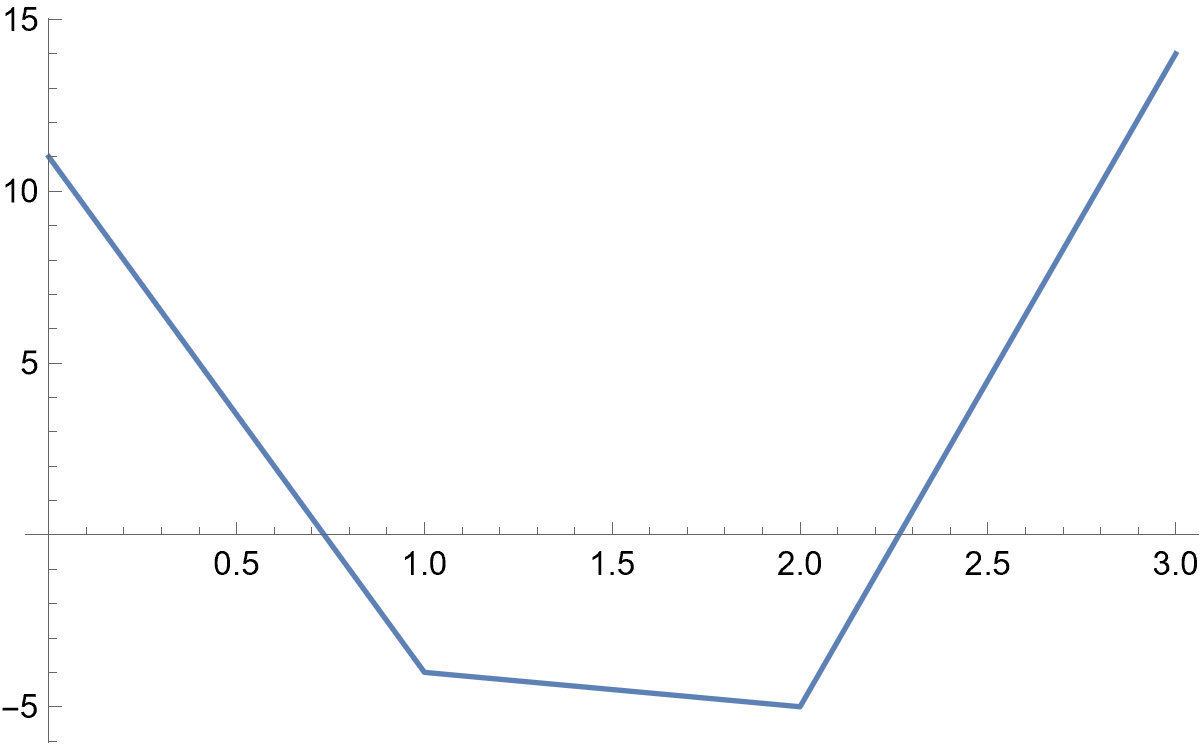
The true answer is $\displaystyle\frac{9}{2}$.
For the second test case, the true answer is $\displaystyle \frac{76}{17}$.
Subtasks
For all data, $1 \le A \le n \le 10^5$, $1 \le \sum n \le 10^5$, $-10^6 \le a_i \le 10^6$.
| Subtask ID | $n \le$ | $A$ | Score |
|---|---|---|---|
| $1$ | $1$ | Not guaranteed | $3$ |
| $2$ | $2$ | $5$ | |
| $3$ | $3$ | $7$ | |
| $4$ | $5$ | $14$ | |
| $5$ | $14$ | $12$ | |
| $6$ | $80$ | $12$ | |
| $7$ | $1\,000$ | $12$ | |
| $8$ | $10^5$ | $A = 1$ | $10$ |
| $9$ | Not guaranteed | $25$ |